
Key points
- SMA is autosomal recessive — a child must inherit a faulty SMN1 gene from both parents.
- Carriers have one faulty copy, are healthy, and usually don't know they are carriers.
- When both parents are carriers, each pregnancy has a 25% chance of SMA.
- A simple blood test can show whether someone is a carrier.
SMA is a genetic neuromuscular disease. Genetic conditions are caused by differences or “faults” in our genes — the instructions our bodies use to make proteins.
The genes involved
SMN1 — SMA is caused by a fault in the Survival Motor Neuron 1 gene. In a healthy person, two working copies of SMN1 produce SMN protein, which is critical for the nerves that control our muscles. Without it, these nerve cells cannot function properly and eventually die, leading to muscle weakness.
People with SMA have two faulty copies of SMN1. In more than 95% of people with SMA, a part of the gene called exon 7 is missing from both copies.
SMN2 — A second, “back-up” gene also makes SMN protein. Because of a single-letter difference from SMN1, most of the protein SMN2 makes is incomplete; only about 10% is functional.
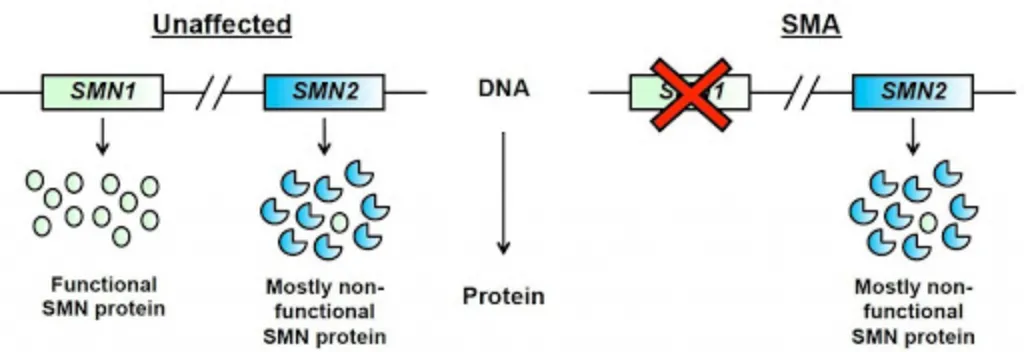
Figure adapted from Burghes, A.H. and Beattie, C.E.
Unlike most genes, the number of SMN2 copies varies from person to person. More copies are generally linked to milder symptoms, but the type or severity of SMA cannot be predicted from SMN2 copy number alone — other genetic factors also play a role.
How SMA is inherited
SMA is autosomal recessive. The SMN1 gene sits on chromosome 5, one of the 22 pairs of non-sex chromosomes, so SMA affects boys and girls equally. A person has SMA only if they inherit two faulty copies of SMN1 — usually one from each parent.
A person with one faulty copy and one healthy copy is a carrier. Carriers have no symptoms, but can pass the faulty gene on to their children. Around 1 in 50 people is a carrier, and most find out only when a child is diagnosed.
When both parents are carriers
For each pregnancy, the chances are:
| Outcome | Chance |
|---|---|
| Child does not have SMA and is not a carrier | 1 in 4 (25%) |
| Child does not have SMA but is a carrier | 2 in 4 (50%) |
| Child has SMA | 1 in 4 (25%) |
When one parent is a carrier
| Outcome | Chance |
|---|---|
| Child has SMA | Very unlikely* |
| Child does not have SMA and is not a carrier | 2 in 4 (50%) |
| Child does not have SMA but is a carrier | 2 in 4 (50%) |
*In rare cases a new change in the SMN1 gene happens in the egg or sperm, or a carrier's gene change cannot be detected by current tests. In these situations a child can have SMA even though only one parent appears to be a carrier.
The chances are the same for every pregnancy, like a coin toss. Having one child with SMA does not change the chances for future children.
Carrier testing
A DNA test on a blood sample is the only way to know if someone is a carrier. It detects about 95% of carriers. Carrier testing is now available at many leading hospitals and laboratories in India.
We encourage parents, brothers and sisters, and other close relatives of a person with SMA to consider carrier testing, and couples planning a pregnancy to discuss it with their doctor. Deciding whether to have genetic testing is personal — we strongly recommend talking it through with a doctor or genetic counsellor first.
Choices for couples who are carriers
Reproductive decisions can be sensitive. Options include prenatal testing during pregnancy, pre-implantation genetic diagnosis (PGD) with IVF to select unaffected embryos, and adoption. See Diagnosis & testing for more on prenatal tests.
We believe every family has the right to choose what is best for them. We help families understand their options and provide resources, but we do not advocate any particular course of action. Please discuss your situation with an expert physician and a genetic counsellor before deciding.